Every Louisiana storm has, somewhere in its official history, a chef with a propane burner.
In August 2021, Hurricane Ida made landfall as a Category 4 at Port Fourchon. By the time it passed over New Orleans the winds had dropped a notch, but the city was dark. The power grid, which had been upgraded exhaustively after Katrina, failed over a wider area than any utility had modelled. For nine days, large parts of the metro region had no electricity.
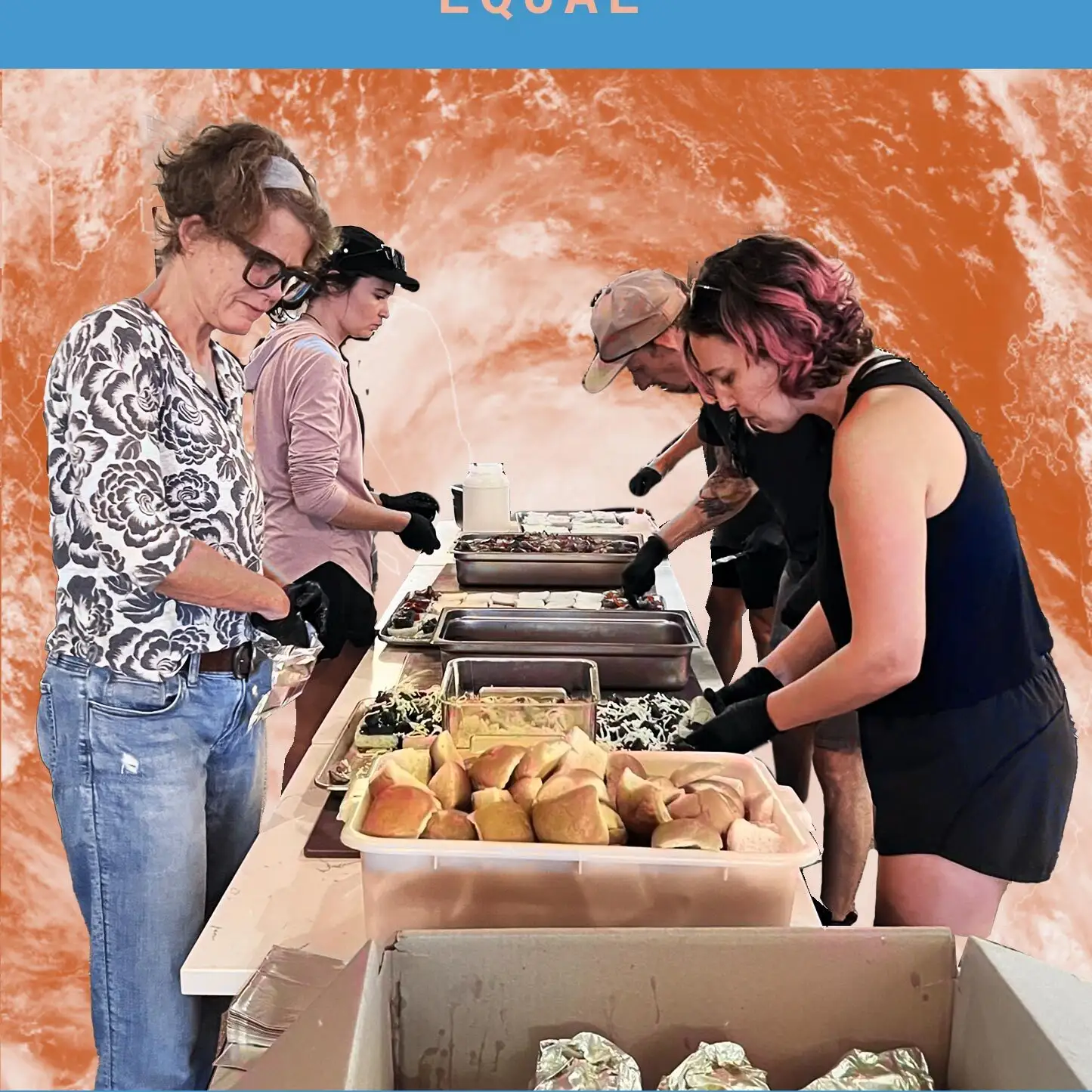
Within hours of the all-clear, chef Alon Shaya was running meals out of Saba. Nina Compton was cooking at Compère Lapin for first responders. Dickie Brennan's kitchen at Palace Café stayed on for anyone with a hotel wristband or a FEMA badge. World Central Kitchen set up a staging point in the Convention Center. By the end of the week more than 100,000 meals had been served, almost all of them by restaurant kitchens working outside their normal routines, with their own staff, on gas.
This is not an unusual pattern. It has happened after every major Louisiana storm since 2005. The question worth asking — and the question that quietly shaped ShaSha's business model — is why.
Why kitchens are good at this
A commercial kitchen is a small, mobile, resilient disaster-response platform that happens to also serve dinner. Three features make it so:
- Backup energy. Most restaurants have propane. Many have generators. In a city that loses power regularly, this is uncommon.
- Scaled procurement. A kitchen that serves 200 people a night already has relationships with wholesalers, cold-chain logistics, and bulk purchasing. In a disaster, you can scale a kitchen that scales food up to 2,000 meals a day faster than you can scale a food bank up to 2,000 meals a day.
- Trained labour. Restaurant cooks and dishwashers already know how to work six-hour pushes in loud, hot, chaotic rooms. Volunteer labour is wonderful but has to be onboarded; a line cook can produce food within fifteen minutes of walking in.
What the city has learned
Katrina was the first storm where this pattern became visible nationally — Willie Mae's Scotch House, Dooky Chase, and dozens of smaller kitchens helped feed the city for weeks. By Hurricane Isaac in 2012 the pattern was systematised. By Ida in 2021 it was essentially the plan. The City of New Orleans Office of Homeland Security & Emergency Preparedness now partners pre-emptively with restaurants and non-profit kitchens.
Culture Aid NOLA, formed in 2020 initially as a Covid food-rescue project, became one of the city's primary post-storm distribution networks. It is run almost entirely by hospitality workers. Its model is simple: when the storm comes, kitchens cook, drivers drive, and the organisation keeps the paperwork.
"We're not pretending to be a social service agency. We're a bunch of restaurant people who got tired of waiting for the state to figure out how to feed our neighbours." — Devin De Wulf, Culture Aid NOLA, 2022
The problem with ad-hoc
What's remarkable about hospitality-led disaster relief is how well it has worked. What is still unresolved is how fragile it remains financially. Most restaurants that cook for free in a disaster lose money doing it — ingredients, overtime, insurance that doesn't cover disaster cooking, the delayed re-opening of a damaged dining room. Many kitchens that helped after Ida closed within a year.
The chef Alon Shaya has written about this. So has Nina. The pattern of "work free in a disaster, lose business in the recovery, close in the year that follows" is the hidden cost of a system that otherwise works beautifully.
What ShaSha is building
ShaSha's 10%-of-profits commitment is a direct response. The idea is simple and ought to be unremarkable: our business model is designed around the fact that we will, eventually, need to cook for free. We ring-fence 10% of profits into a Mutual Pour Fund administered through established local partners (SBP, Culture Aid NOLA, Second Harvest Food Bank), and we draw on it to subsidise our own disaster response as well as to send money to partners who are already in motion.
Three things make the fund unusual, we think:
- It's set aside before the storm. We don't fundraise after an event. The money is already there. Hospitality-led response works best when it doesn't have to pass the hat first.
- It's not just for our own disaster cooking. We would rather give the money to a kitchen that is closer to the affected neighbourhood than ours.
- It's publicly reported. Each quarter we publish an itemised ledger — amount, partner, use. Members can read it. The public can read it. If we fall short, you'll know.
What members can do
Being a member is the biggest thing. The membership model is what makes the 10% commitment possible — predictable revenue, built-in community, and a room that doesn't rely on a lucrative Saturday to make rent.
Beyond membership, there are three organisations we unconditionally recommend supporting directly, independent of us:
- SBP (sbpusa.org) — long-term disaster recovery and rebuilding, founded in St. Bernard Parish.
- Culture Aid NOLA — hospitality-industry food distribution.
- Second Harvest Food Bank — the regional food bank, serving 23 Louisiana parishes.
Where this goes
We hope ShaSha is one of several bars and restaurants to adopt this kind of model. We think it is one of the few business-model innovations the hospitality industry has access to that is both profitable and good. A room that is designed to help the city, not in spite of its business model but through it, is the kind of room we want to drink in.
If you'd like to join us at the top of the list, you know where to find the membership page.